Chart you can tap
Best time to visit Cape Point, month by month
Light through the year
Twelve months of sun and shade
Choose a month to compare sunset, day length and the usual warmth around Cape Point.
Sunset
Jun
Mid-June has 9.9 hrs of sun above the horizon, so the day is short.2
Jul
The average daily high in July is 18.5 °C.2
Dec
Mid-December has 14.4 hrs of sun above the horizon, so the day is long.2
Sunset is worked out for the 15th of each month on South African time. Day length is for Cape Point; temperatures come from the NOAA station at Cape Town International Airport, an inland airport 44.6 km away, 1971 to 2020 and 1991 to 2020.
Summer is dry and the gate opens early, winter brings rain and whales, and spring brings the fynbos. Here are the months compared, with the data and its limits.
Editorial team, capepointtour.top · Updated November 7, 2026 · Allow 6 min
Overview
- Dry monthsSummer in Cape Town is warm and sunny with very little rain.1
- Wettest monthJune has 88 mm of precipitation at the nearest NOAA station.2
- WhalesSouthern right whales arrive from June until November.3
- FlowersThe fynbos blooms most fully in spring, from September to November.4
- Gate timesThe gate opens 6:00am to 6:00pm from October to March.5
What the numbers can and cannot tell you
Cape Town Tourism describes the city's climate as Mediterranean, with hot summers and mild winters, and adds that the geography of the peninsula gives it several microclimates.6,7 That second point matters for the weather at Cape Point, which sits at the far tip of the peninsula and does not behave like the city.
The nearest weather data used here come from the NOAA station at Cape Town International Airport. It is an inland airport, a long drive from the cape, so its temperatures and rainfall describe the region rather than the headland itself.2 Treat the numbers below as a guide to the season and a way to compare months, and do not read them as a forecast for the clifftop on a given day.
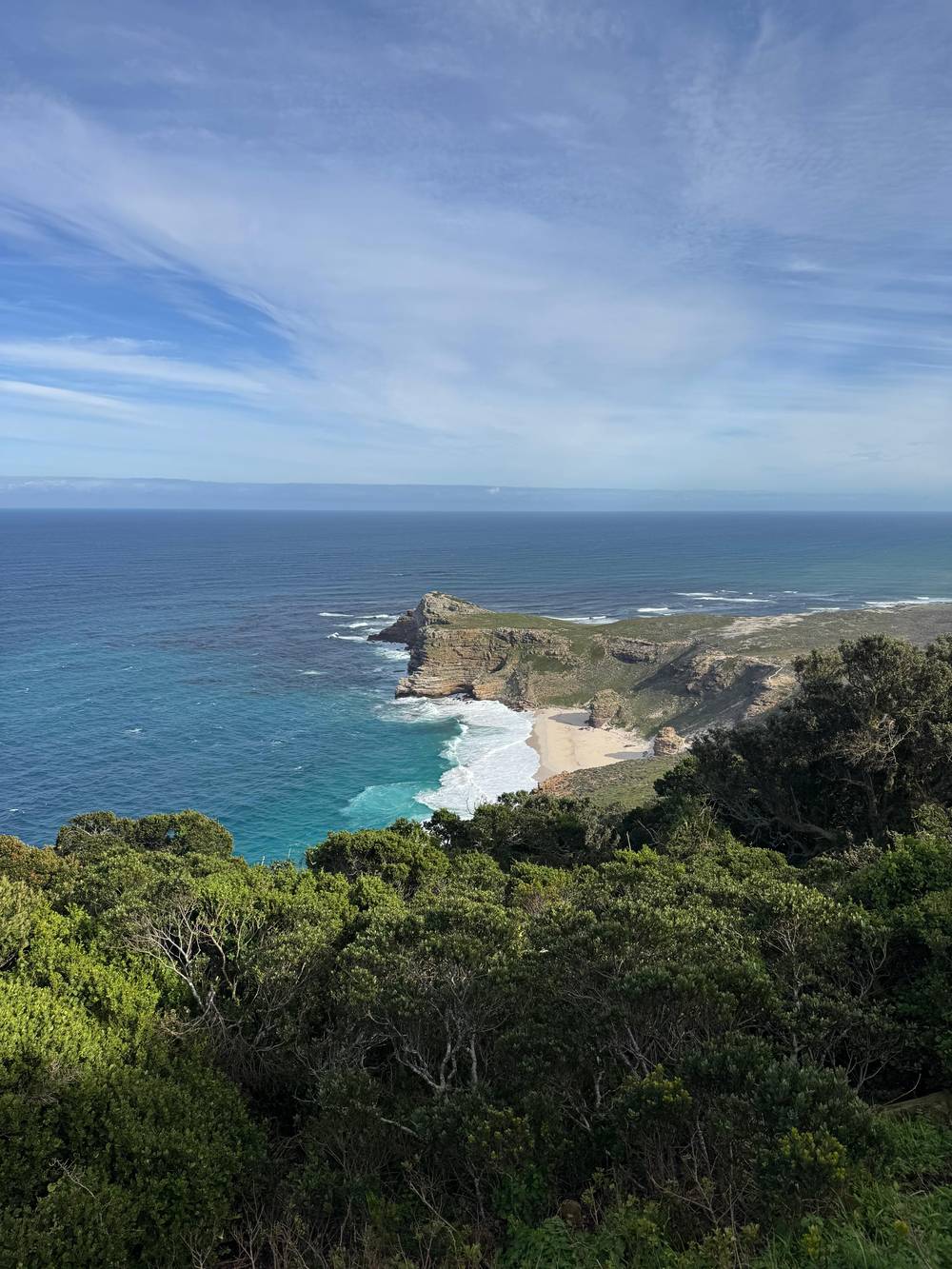
Some things hold in every month. The reserve gate follows daylight, and the weather at the tip can change quickly. Dias named it the Cape of Storms for its notoriously bad weather, which can blow up quickly.8 Carry a jacket in every season, and check a live forecast on the morning you go.
From the nearest NOAA station
Temperatures and rain, by month
| Month | Daily high | Daily low | Rain |
|---|---|---|---|
| January | 27.7 °C2 | 15.7 °C2 | 13 mm2 |
| March | 26.8 °C2 | 14.4 °C2 | 20 mm2 |
| May | 21.6 °C2 | 9.5 °C2 | 71 mm2 |
| June | 19.2 °C2 | 7.6 °C2 | 88 mm2 |
| July | 18.5 °C2 | 6.9 °C2 | 81 mm2 |
| September | 20.2 °C2 | 9.3 °C2 | 31 mm2 |
| October | 23 °C2 | 10.6 °C2 | 33 mm2 |
| December | 26.8 °C2 | 15.1 °C2 | 12 mm2 |
Averages for Cape Town International Airport, inland from the cape, so the headland is windier and usually cooler on the same day.
Summer: long days, early gates and little rain
From October to March the reserve gate is open 6:00am to 6:00pm, and the funicular runs 9:00am to 5:30pm.5 December has the longest days in the monthly record, with the sun above the horizon for 14.4 hrs at mid-month.2 That gives a visitor the most time on the headland, and the earliest gate gives a sunrise start.
Cape Town Tourism says summer is warm and sunny with very little rain.1 At the airport station, January has an average daily high of 27.7 °C and 13 mm of precipitation, and February has a high of 28.2 °C and 16 mm.2,2 The cape itself is exposed, so a layer for the wind is wise even when the airport figures look hot.
At Boulders Beach it is best to arrive early in the peak summer months.10 Parking there is limited, so a summer visit rewards an early start.11
Autumn: shoulder months and returning rain
March still feels like summer at the airport station, with an average daily high of 26.8 °C and 20 mm of precipitation.2 April is where the change shows: 57 mm of precipitation falls in the month, on 5 days with at least 2.5 mm.2 May continues the trend with 71 mm and a daily high of 21.6 °C.2
The gates move from the summer hours to the winter hours in April, so the window shrinks as the rain increases. From April to September the gate is open 7:00am to 5:00pm.9 A day tour plans for those hours by itself, but a self-drive visitor should work back from the closing time rather than forward from breakfast.
For a traveler with flexible dates, March is the strongest of the autumn months on the figures, with the least rain and the most daylight of them. The later weeks of autumn suit those who prefer cooler air for the walks, as long as they accept a higher chance of a wet day.2,2
Match your visit
Which month fits your priority?
Choose the line that sounds like your plan and read the answer beside it
If I want the driest days
Go in summer
Summer is warm and sunny with very little rain.1
If I want whales from the cliffs
Go from June to November
Southern right whales arrive from June until November.3
If I want flowers on the headland
Go in September to November
The fynbos blooms most fully in spring, from September to November.4
If I want the longest opening hours
Go from October to March
The gate is open 6:00am to 6:00pm in those months.5
If I dislike crowds and wind
Skip the summer weekend peak
Boulders Beach is best reached early in the peak summer months.10
Winter: rain, short days and the whales
Cape Town has frequent rain in the winter months, and Cape Town Tourism calls winter the rainy season.16,15 At the airport station, June has 88 mm of precipitation on 7 days with at least 2.5 mm, July has 81 mm and August 66 mm.2,2,2 Mid-June has the shortest daylight, with the sun above the horizon for 9.9 hrs.2
Winter highs sit between 18.5 °C and 19.2 °C at the airport, with lows between 6.9 °C and 7.6 °C.2,2,2 On the headland the wind adds to that, so a proper jacket matters more than any other item on the packing list. The gate is open 7:00am to 5:00pm.9
Winter has a reward as well. Southern right whales arrive on the Cape coast from June through November, and the operator says whales move past Cape Point on their migration around June to October.3,17 Cape Point is among the listed high vantage points for whale watching on False Bay.18 The Chapman's Peak toll road shuts in high winds and heavy rain, so keep the bay road as your backup.13
Price the day
What a Cape Point day costs your group
Type your party size and compare four ways to go
Choose from 4 options
What a Cape Point day costs your group
Type your party size and compare four ways to go
- Full-day group tourOur own pick · per individual from $44
≈
View - Half-day group tourShorter day · per individual from $40
≈
View - 8-hour group tourLower from-price · per individual from $30
≈
View - Private day tourYour own party · starts at $151
≈
View
Starting prices on GetYourGuide, exchanged at the ECB reference rate. The booking page gives the exact price.
The year at the Cape
What each part of the year offers
Summer
Dry and long days
Summer is warm and sunny with very little rain, and the gate opens at 6:00am from October to March.1,5
Autumn
Rain returns
April has 57 mm of precipitation, and from April the gate opens at 7:00am.2,9
June to November
Whale season
Southern right whales arrive on the Cape coast from June through November.3
Winter
Wettest and cool
June has 88 mm of precipitation, the most of any month at the nearest station.2
September to November
Fynbos in flower
The fynbos blooms most fully in spring, just after the winter rains.4
October
Early gates again
From October the gate is open 6:00am to 6:00pm once more.5
Spring: fynbos in flower and the last whales
The fynbos blooms most fully in spring, from September to November, just after the winter rains.4 The reserve holds over 1,100 species of indigenous flora, so the headland changes character in these months.19 Walking the boardwalk trails in spring is a different experience from the same walk in January.
At the airport station, September has 31 mm of precipitation, October 33 mm and November 19 mm.2,2,2 Daily highs rise from 20.2 °C in September to 24.6 °C in November.2,2 Humpback whales are most likely to be seen between May and November, so the early part of spring still offers a chance of whales.12
October brings the summer gate hours back, 6:00am to 6:00pm, which suits a sunrise start.5 Spring combines flowers, moderate rain, whales and long gate hours, and it is a sound pick if you can choose freely and want more than dry weather.
Video
Why Cape Point is worth the visit
Just The Barry's on YouTube · Your tap on play is what loads the video.
He named it the Cape of Storms, for the notoriously bad weather, which can blow up quickly.
Before you pick a date
Weather checklist for Cape Point
Check first4
Wind, fog and the Cape of Storms
The Cape Point operator says Bartolomeu Dias named the point the Cape of Storms for its notoriously bad weather, which can blow up quickly.8 By night and in fog the Point was a menace to ships, and the original lighthouse was ineffective in mist, which is why a second one was built lower.20,21 The history tells you what to expect from a cloudy day: the view can disappear.
The same wind affects the roads. Chapman's Peak Drive is closed from time to time for safety, typically in high winds, heavy or continuous rain, for maintenance or to clear rocks from the catch fences.13 If the forecast shows a strong blow, plan for the False Bay side, and treat the lighthouse and the Cape of Good Hope sign as the stops that need a clear window.
On a day tour the operator handles the driving, and the listing's terms allow a full refund up to 24 hours before. For a self-drive trip, keep one hour of slack in the plan and a layer in the car, and expect that a good-looking morning at the airport can still turn into a hazy clifftop.
Which month to choose
For the highest chance of dry weather and the longest opening hours, summer wins. The airport station shows January and February with 13 mm and 16 mm of precipitation, and the gate is open 6:00am to 6:00pm.2,2,5 Book ahead for popular days.
For flowers, choose September to November, when the fynbos is in full flower.4 For whales, aim for June to November, with Cape Point listed among the high vantage points.3,18 Both of those windows carry a higher chance of rain than January does, and in winter the gate closes at 5:00pm.9
If you are booking the site's day tour, the listing is a 10-hour outing with free cancellation up to 24 hours before, so you can wait for a reliable forecast before you commit. The Boulders colony and Simon's Town are on the tour's stop list for any month.
FAQ
Quick questions get quick answers.
What is the best month to visit Cape Point?
When does it rain most near Cape Point?
When is the whale season at Cape Point?
When do the fynbos flowers bloom?
The fynbos blooms most fully in spring, from September to November, just after the winter rains.4
What are the gate hours in winter?
From April to September the gate is open 7:00am to 5:00pm, and the funicular 9:00am to 5:00pm.9
Is the climate data from Cape Point itself?
The data come from the NOAA station at Cape Town International Airport, which is inland and a long drive from the cape.2
Does fog affect the lighthouse?
Can wind close Chapman's Peak Drive?
It closes from time to time, typically in high winds or heavy rain.13
Sources
- Cape Town Tourism (the city of Cape Town's official Regional Tourism Organisation, capetown.travel) · Weather in Cape Town ↩
- NOAA · Global Summary of the Month, Station Cape Town International (NOAA GHCN SFM00068816), 1971 to 2020 + 1991 - 2020 ↩
- Cape Town Tourism (the city of Cape Town's official Regional Tourism Organisation, capetown.travel) · Whale Watching in Cape Town ↩
- South African Tourism (southafrica.net) · Table Mountain Marine Protected Area: where mighty currents mingle ↩
- Cape Point (concession operator of the Cape Point facilities, capepoint.co.za) · Visitor's Info ↩
- Cape Town Tourism (the city of Cape Town's official Regional Tourism Organisation, capetown.travel) · Weather in Cape Town ↩
- Cape Town Tourism (the city of Cape Town's official Regional Tourism Organisation, capetown.travel) · Weather in Cape Town ↩
- Cape Point (concession operator of the Cape Point facilities, capepoint.co.za) · About ↩
- Cape Point (concession operator of the Cape Point facilities, capepoint.co.za) · Visitor's Info ↩
- Cape Town Tourism (the city of Cape Town's official Regional Tourism Organisation, capetown.travel) · Your Guide to Boulders Beach ↩
- Cape Town Tourism (the city of Cape Town's official Regional Tourism Organisation, capetown.travel) · Your Guide to Boulders Beach ↩
- Cape Town Tourism (the city of Cape Town's official Regional Tourism Organisation, capetown.travel) · Whale Watching in Cape Town ↩
- Chapman's Peak Drive (the toll road operator's own site, chapmanspeakdrive.co.za) · Terms of entry ↩
- Cape Town Tourism (the city of Cape Town's official Regional Tourism Organisation, capetown.travel) · How to Spend a Day at Cape Point ↩
- Cape Town Tourism (the city of Cape Town's official Regional Tourism Organisation, capetown.travel) · Meet The Penguins At Boulders Beach ↩
- Cape Town Tourism (the city of Cape Town's official Regional Tourism Organisation, capetown.travel) · Weather in Cape Town ↩
- Cape Point (concession operator of the Cape Point facilities, capepoint.co.za) · Visitors Info ↩
- Cape Town Tourism (the city of Cape Town's official Regional Tourism Organisation, capetown.travel) · Whale Watching in Cape Town ↩
- Cape Town Tourism (the city of Cape Town's official Regional Tourism Organisation, capetown.travel) · Here's What Not to Miss On Your Next Cape Point Visit ↩
- Cape Point (concession operator of the Cape Point facilities, capepoint.co.za) · About ↩
- Cape Point (concession operator of the Cape Point facilities, capepoint.co.za) · About ↩
Next read